
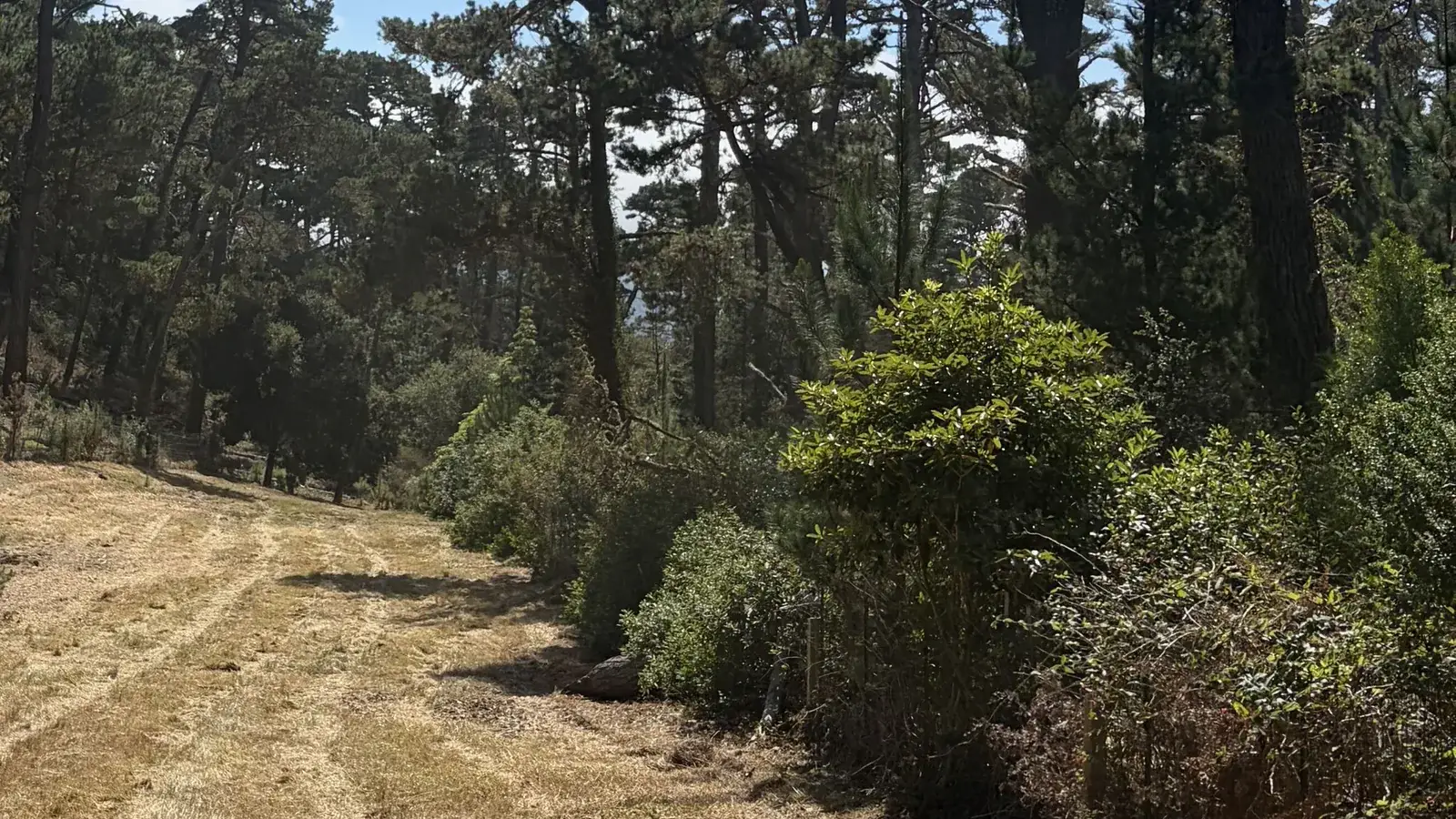
What Are the Defensible Space Requirements in California?
California’s defensible space law, Public Resources Code 4291, requires 100 feet of defensible space around a building. It covers the State Responsibility Area, where CAL FIRE has primary responsibility for wildfire protection. In cities and fire districts, Government Code 51182 sets the same 100 feet in Very High zones.
Today the rule has two zones, 0 to 30 feet and 30 to 100 feet. Zone 0, the first 5 feet, is adopted but not in effect yet. We are based in Seaside and do defensible space clearing across the Monterey Peninsula. These are the rules we clear to.
What does the state’s defensible space law require?
The law applies to anyone who owns, leases or maintains a building in the State Responsibility Area. Fuels must be kept and spaced so a wildfire would be unlikely to ignite the structure. The 100 feet stops at your property line, and single well-pruned trees can stay.
The law also says to remove any part of a tree within 10 feet of a chimney outlet. Keep plants over the house clear of dead wood, and keep the roof clear of leaves and needles. Local agencies can require more than the state minimum.
What do Zone 1 and Zone 2 require?
The zone rules in force come from the Board of Forestry and Fire Protection, in 14 CCR 1299.03. The closer zone gets the strictest treatment.
| Where | What the state rule asks for |
|---|---|
| Zone 1 (0 to 30 feet) | Remove dead or dying plants, grass, weeds, leaves and needles. Keep branches 10 feet from chimneys. Move exposed firewood out unless it is fully covered. Clear flammable material from under decks. |
| Zone 2 (30 to 100 feet) | Cut annual grasses and weeds to 4 inches or less. Space shrubs and trees apart. Remove dead woody fuel. Litter can stay up to 3 inches deep. |
| Firewood in Zone 2 | 10 feet clear to bare mineral soil on all sides. |
| Propane tanks and outbuildings | 10 feet cleared to bare mineral soil, plus 10 more feet with no flammable plants. |
How far apart should shrubs and trees be?
Spacing depends on slope. These are the Board’s guidelines, which CAL FIRE also publishes.
| Slope | Gap between shrubs | Gap between tree crowns |
|---|---|---|
| Under 20 percent | 2 times shrub height | 10 feet |
| 20 to 40 percent | 4 times shrub height | 20 feet |
| Over 40 percent | 6 times shrub height | 30 feet |
CAL FIRE also says to keep tree branches at least 6 feet off the ground. Between a shrub and the branches above it, leave three times the shrub’s height. On a steep chaparral slope, that often means taking out a lot of brush. That is where brush clearing on steep hillsides comes in.
Is Zone 0 required yet?
Not yet. The Board adopted the Zone 0 rules on August 19, 2026, and says final state review is still underway. The rules take effect once the Secretary of State files them. Monterey Fire’s 2026 notice says the zone “is not required yet.”
Once in effect, new homes comply right away. Existing homes get three to five years for most items. The adopted text asks for this in the first 5 feet:
- No bark or wood chip mulch, dead leaves, needles or firewood.
- Nothing that can catch fire under decks and stairs.
- No plants under eaves, within 1 foot of walls, or within 2 feet of windows, doors and vents.
- Elsewhere in the zone, only short, well-kept plants without woody stems, or small plants in noncombustible pots.
- A 5-foot noncombustible section where a fence or gate meets the house.
What does a defensible space inspector look for?
CAL FIRE and its partners inspect in the State Responsibility Area. Where a city or fire district is responsible, it inspects, often under its own ordinance. Inspectors note problems on CAL FIRE’s form LE-100a or a local form, set a time limit and come back.
Monterey County Regional Fire District’s checklist shows what its inspectors look at. It lists dead plants, grass over 4 inches, branches near chimneys, wood piles and propane tank clearance. It also asks for readable address numbers and driveway brush cut back 12 feet wide and 15 feet high.
In the State Responsibility Area, a first violation is an infraction with a $100 to $500 fine. After a third conviction within five years, CAL FIRE may do the work and bill the owner.
Who inspects on the Monterey Peninsula?
- Monterey Fire Department inspects yearly in Monterey, Pacific Grove and Carmel-by-the-Sea. Its 2026 round began May 1.
- Monterey County Regional Fire District covers the Carmel Valley and the Toro Park area along Highway 68. It also inspects for home sales.
- In Pebble Beach, the community services district contracts with CAL FIRE for fire protection.
- In the State Responsibility Area, the local CAL FIRE unit is the San Benito-Monterey Unit.
The state’s 2025 fire hazard map shows Very High zones inside Monterey, Pacific Grove, Carmel-by-the-Sea and Seaside. Check your parcel on the state’s map viewer.
How does defensible space affect insurance?
The Department of Insurance runs Safer from Wildfires. It says each step on its list can help you save money on insurance. Steps include defensible space that meets the law, a 5-foot ember-resistant zone and clear space under decks.
Community status counts too. The Board’s 2026 Fire Risk Reduction Communities list includes the Monterey Fire and Pebble Beach areas. Both agencies say insurers must consider the listing, so owners may qualify for lower premiums from July 1, 2026. Monterey Fire’s area takes in Monterey, Pacific Grove, Carmel-by-the-Sea and Sand City.
Insurers still set their own rules. By law, though, an insurer can require more than 100 feet only if a designated fire expert finds it necessary. Got a letter from your insurance company? The Board’s 2026 guidance says sharing photos of your fuel work may help.
What can you do yourself, and what should you hire out?
Much of Zones 0 and 1 is yard work: raking needles, cleaning gutters, moving firewood and swapping mulch for gravel. CAL FIRE says to mow grass before 10 a.m. and never on a hot or windy day.
Some jobs belong to other trades. Limbing trees and cutting branches near the chimney is a tree service’s work. Vents, eaves, roofing and attached fences are building work.
Brush is where a machine pays off. A compact track loader with a masticating head grinds brush, saplings and small trees into mulch where they stand. The trees you keep stay standing, and the mulch keeps the soil covered.
Two cautions. Keep wood mulch out of the first 5 feet, where CAL FIRE calls for gravel, pavers or concrete. And check tree rules, because the City of Monterey protects trees 6 inches or more in diameter on developed lots.
Past the 100 feet, fire breaks and fuel breaks give crews room to work along ridges and property lines. For a weed notice on a lot, read what a weed abatement notice asks for.
How do you get your 100 feet ready on the Monterey Peninsula?
Start with the notice or letter in hand; it says what your agency or insurer wants. The fire agency inspects, and we clear to its standard. We work from Seaside across the Monterey Peninsula, the Salinas area and up the coast to Santa Cruz.
We run a compact track loader with a masticating head and a brush mower. Call or text (831) 200-5377 about clearing the 100 feet around a home. We look at the property, or your photos, and put the quote in writing.