
How Much Does Land Clearing Cost per Acre in California?
One national cost guide puts land clearing at $1,200 to $8,000 an acre. Shrubs and small trees land near the bottom of that range. Dense growth with large trees lands at the top. Cost guides price forestry mulching, the work fuel-reduction crews call mastication, near $400 to $800 an acre.
A UC Cooperative Extension publication looks at fuel reduction on private forest land in California. It puts removing shrubs and smaller trees at $1,000 to $3,000 an acre. These are market numbers, not our price list. We price land clearing on the Central Coast after we see the ground or your photos.
What does land clearing cost per acre, by what grows on it?
Every row below comes from a published guide. The guides tie the price to what grows on the acre and how dense it is.
| What grows on the acre | Published cost per acre | Kind of source |
|---|---|---|
| Brush clearing | $330 to $630 | National cost guide |
| Forestry mulching | $400 to $800 | National cost guide |
| Forestry mulching in dense overgrowth | Up to $2,000 | National cost guide |
| Brush removal | $800 to $3,000 | National cost guide |
| Shrubs and smaller trees, California fuel reduction | $1,000 to $3,000 | UC Cooperative Extension publication |
| Lightly wooded land | $733 to $2,333 | National cost guide |
| Heavily wooded land | $3,395 to $6,155 | National cost guide |
| Dense growth, thick underbrush and large trees | $4,500 to $8,000 | National cost guide |
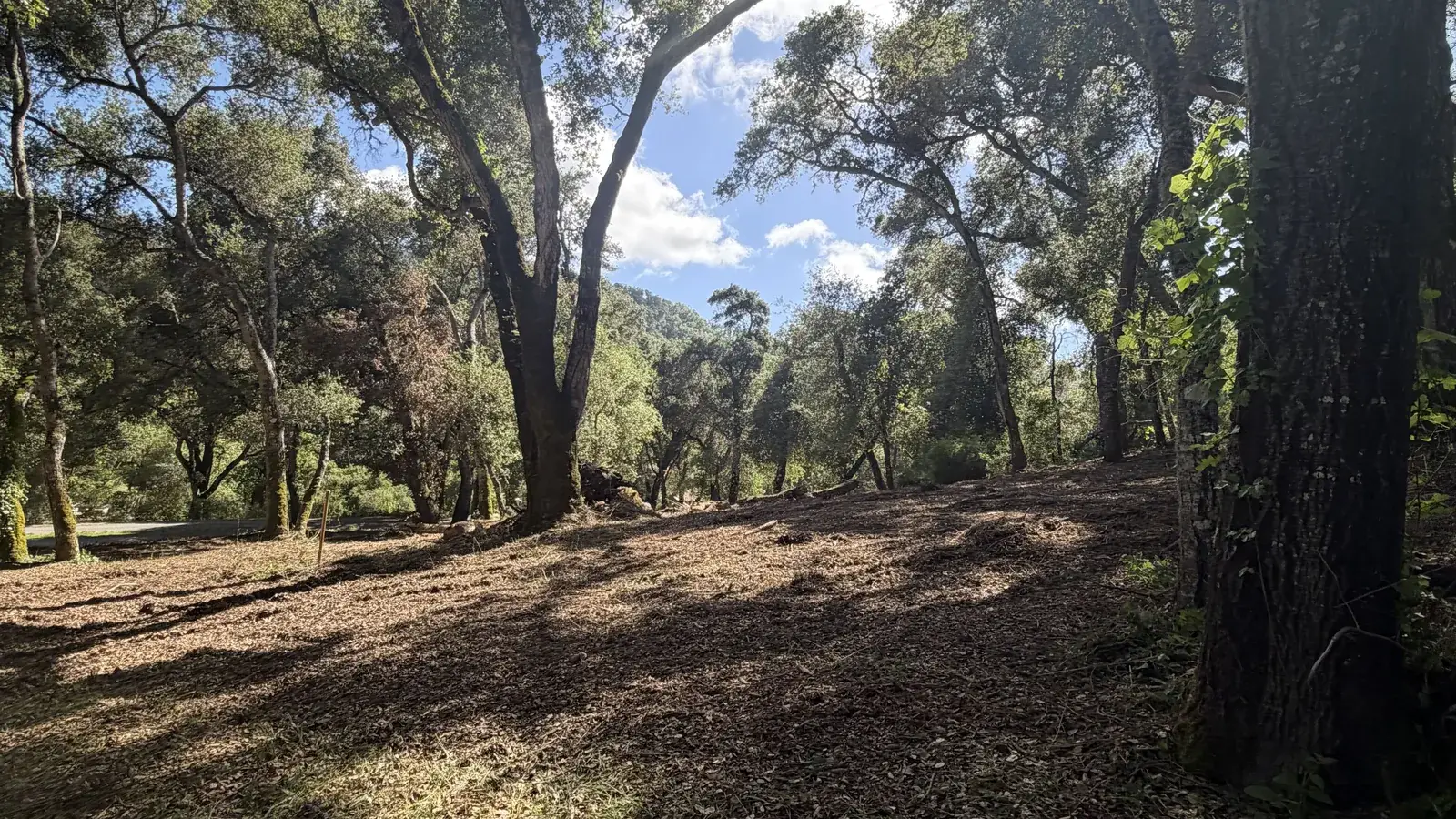
In each guide that lists both, brush work starts lower than wooded ground. One guide calls removing trees the most costly part of clearing a lot. On the Central Coast, wooded ground often means oak woodland or Monterey pine. When you keep those trees, the job is the brush under them, and larger trees are a tree service’s work.
Why does heavy chaparral cost more to clear than light brush?
Chaparral is dense shrubland of plants like chamise and manzanita. A Forest Service species review says about 60 percent of chamise stems are under half an inch thick. Those small stems fill the shrub from the ground up. As a stand ages, dead material builds up, and within 30 years it can make up half the fuel.
One national guide says heavy overgrowth takes longer to mulch than light brush. It prices forestry mulching in dense overgrowth at up to $2,000 an acre. The same guide says mulching around many trees adds difficulty and cost. Brush under oaks you keep is that kind of job.
The masticating head grinds brush, saplings and small trees into mulch where they stand. The roots stay in the soil under a layer of mulch.
Does mastication cost less than clearing and hauling?
Full clearing uses bulldozers and excavators to take out everything above and below ground, one national guide says. The material then has to go somewhere. Some companies include disposal in the base price, and others bill it separately.
Hauled brush also carries a dump fee. The Peninsula’s regional waste district posts $54 a ton for yard trimmings, a rate that excludes poison oak and broom. Logs and stumps over 3 feet in any dimension run $112 a ton.
With mastication, the brush becomes mulch where it stands and stays on the ground as cover. One national guide lists forestry mulching at $400 to $800 an acre and full land clearing at $1,200 to $8,000. Another guide counts the saved debris removal as a plus.
A house pad still needs grading after the brush is gone, and that is excavation work. Our brush clearing cost guide breaks down hourly rates and haul-off fees.
What changes the price on a Central Coast hillside?
Slope slows the machine. Cost guides say equipment moves slower on hills, and steep ground can call for different equipment or added safety steps. One guide says crews clear 2 to 4 acres a day on a flat field with light growth. On a steep slope with thick brush, it puts the pace at about an acre or less.
Monterey County’s erosion control code adds its own limits. It defines land clearing as removing vegetation down to duff or bare soil. Unless it is part of a permitted project, that kind of clearing is barred on slopes over 30 percent.
Under the North County Land Use Plan, the line is 25 percent. Exceptions take an application and a public hearing.
Winter brings another limit in water supply watersheds and high erosion hazard areas. There, clearing over 1 acre a year on a site cannot run from October 15 to April 15. The county’s director of building inspection can authorize an exception.
Location and size matter too. A Forest Service study of California fuel work found higher costs per acre in the wildland-urban interface. One cost guide adds that a single acre costs more per acre than five acres.
On a ranch, a fire break along a ridge or road is a long strip. Its length times its width sets the acreage.
Which permits add cost in Monterey County?
Oaks come first. The county’s oak rule covers unincorporated land outside the coastal zone. In the Carmel Valley and Toro plan areas, among others, it protects oaks six inches or more across. The trunk is measured two feet above the ground.
The rule covers removing or killing a protected tree, and trimming off more than a third of its green foliage. The county’s planning director can approve removing up to three protected trees per lot a year. The county’s 2026 fee schedule lists that approval at $470.
More than three takes a Forest Management Plan from a professional forester, paid by the owner. It also takes a Use Permit from the Planning Commission. The county lists that tree removal permit at $2,740. The code also calls for replacing or relocating each removed tree, one for one.
In the unincorporated coastal zone, the county’s coastal zoning code counts removing major vegetation, including land clearing, as development. Development there needs a Coastal Development Permit unless the code exempts it. The 2026 schedule lists that permit at $12,510.
Past 2.5 acres a year on a site, the erosion control code calls for a land clearing permit. The application includes an erosion control plan. In water supply watersheds and high erosion hazard areas, the permit starts past 1 acre.
The county adds a 13 percent technology fee to permit fees. Work done without a required permit is charged double the permit fee. The county’s planning office answers what applies to your parcel, and we point you there. Cities and Santa Cruz County set their own rules.
How do you get a real number for your land?
Published ranges only go so far. The real number depends on your ground and what you want left standing.
We are based in Seaside on the Monterey Peninsula. We work across the Salinas area and up the coast to Santa Cruz. We run a masticating head and a brush mower on a compact track loader. Brush becomes mulch in place, and the trees you keep stay standing.
We look at the property, or you send photos, and we put the quote in writing. See how our land clearing works, or call or text (831) 200-5377.