Which Yard Work Counts Toward a Safer from Wildfires Discount?
California’s Department of Insurance lists 10 steps under Safer from Wildfires. It says every action “will qualify you for an insurance discount.” It adds, “By doing more, you can save more.” Five steps harden the house. Four cover the ground and structures around it, and the tenth is your community. Brush and grass work falls under one step: defensible space compliance.
We are based in Seaside and do defensible space clearing in Monterey and across the Monterey Peninsula. Our part is the brush and grass past the first 5 feet. We masticate brush into mulch where it stands and mow grass and weeds. Your insurer, an IBHS evaluator or your fire agency decides what counts.
What counts toward a wildfire mitigation discount in California?
The Department groups the steps in three layers of protection: the structure, the immediate surroundings and the community.
| Step | What the Department describes | Who does the work |
|---|---|---|
| Class A fire-rated roof | Most roofs qualify; wood shake shingles do not | A roofer |
| Ember- and fire-resistant vents | 1/16 to 1/8 inch metal mesh over exterior vents | Another trade |
| 6 inches at the base of the walls | Brick, stone, fiber-cement siding or concrete | Another trade |
| Enclosed eaves | Soffits installed under the eaves | Another trade |
| Upgraded windows | Multi-paned glass or added shutters | Another trade |
| 5-foot ember-resistant zone | Greenery and wood chips swapped for stone or decomposed granite; metal where a wood fence meets the house | You or another trade |
| Under decks | Vegetation, weeds and debris cleared; concrete, gravel or bare soil are allowed | You or another trade |
| Sheds and outbuildings | Combustible ones moved at least 30 feet away | You or another trade |
| Defensible space compliance | Following state and local laws, including trimming trees and removing brush and debris | Us for brush and grass past 5 feet; a tree service for trimming trees |
| Being safer together | Firewise USA or a Fire Risk Reduction Community | Your community or local agency |
The Department’s page gives no dollar amount or percentage. Its Safer from Wildfires regulation covers insurers whose rates change with wildfire risk. Their rating plans must take these steps into account. Ask your insurer how its plan counts each one.
Which steps are yard work, and which are home hardening?
Yard work is the vegetation: brush, grass, dead plants and the spacing between shrubs. Home hardening is the building: the roof, vents, siding, eaves and windows, plus fences and sheds. Hardening and moving a shed are jobs for you or another trade.
The first 5 feet and the ground under decks are yours or another trade’s too. Both programs want that zone clear of plants and wood mulch. Branches over it go to a tree service. The state’s own rule for the first 5 feet is called Zone 0. As of November 2026, the Board of Forestry says the rule is still in final review. For the state’s zones, see California’s defensible space rules.
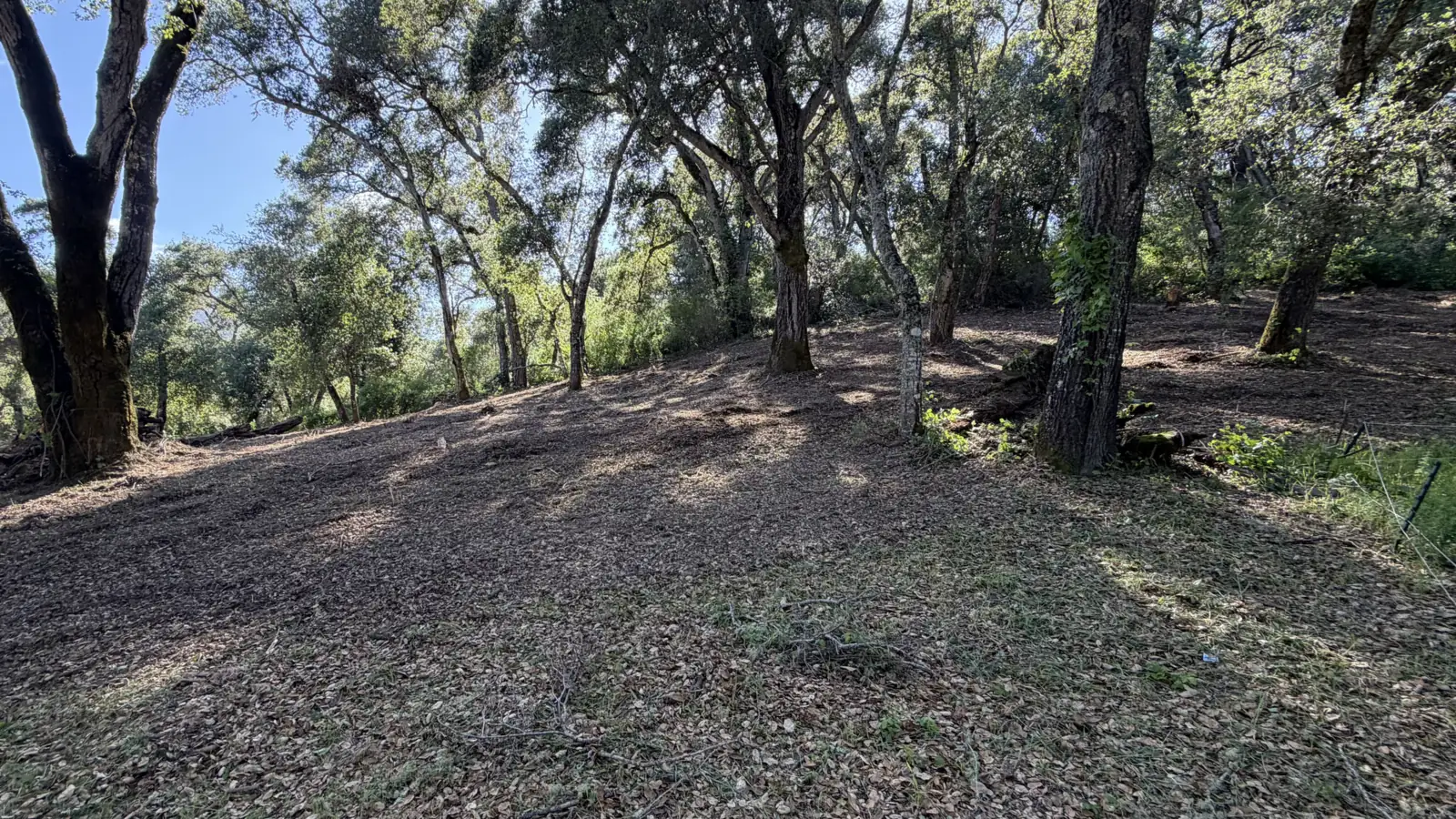
Past the first 5 feet, our masticating head grinds brush, saplings and small trees into mulch where they stand. It runs on a compact track loader, and the trees you keep stay standing.
What does an IBHS Wildfire Prepared Home evaluator want to see in the yard?
IBHS, the Insurance Institute for Business and Home Safety, offers the Wildfire Prepared Home designation in California. It has two levels. Essential focuses on wind-blown embers, which IBHS calls the leading cause of home ignitions. Enhanced builds on Essential with added protection from flames and radiant heat.
Essential asks for 30 feet of defensible space, or to the property line if that is closer. Every required item must be done.
| Distance from the house | What the Essential level asks for | Who does the work |
|---|---|---|
| 0 to 5 feet | No plants, mulch, overhanging branches or combustible items; wood or vinyl fencing replaced with noncombustible fencing | You or another trade; a tree service for branches |
| 5 to 30 feet | Grass under 4 inches; dead plants removed; plants spaced at least twice the height of the tallest plant; shrubs over 2 feet cleared from under trees | Our brush mower and masticating head, for the grass and brush |
| 5 to 30 feet | Lowest branches at least 6 feet up; firewood at least 30 feet from the home | A tree service for branches; you for firewood |
| 10 to 30 feet | No more than 3 detached structures within 30 feet, each at least 10 feet from the home and other structures | You or another trade |
On slopes, IBHS allows grass and groundcover up to 18 inches where it is needed for erosion control. Enhanced adds house work, such as windows with two panes of tempered glass and noncombustible siding. In the yard, Enhanced moves detached structures of 15 square feet or more out to 30 feet.
How do you get a Wildfire Prepared Home designation?
Many people search for a Wildfire Prepared Home certification. IBHS calls it a designation and issues a certificate.
- Do the prep work using the IBHS How-To checklist. IBHS says following it is the homeowner’s responsibility.
- Pay a nonrefundable application fee and send eligibility photos.
- A third-party evaluator visits in person and documents the work that is complete. If more work is needed, you have 60 days to finish it and send photos.
IBHS says its evaluation is not a full-service inspection that lists every fix. When the home meets all requirements, the certificate comes by email. Then ask your insurer how it counts the designation.
Is your neighborhood a Fire Risk Reduction Community or a Firewise USA site?
The Department recognizes two community-wide programs, Firewise USA and Fire Risk Reduction Communities. The regulation makes insurers’ rating plans reflect both.
A Fire Risk Reduction Community is a local agency that meets best practices for local fire planning. It must sit in a state responsibility area or a very high fire hazard severity zone. The Board of Forestry certifies it.
Locally, the 2026 list includes the City of Monterey, the City of Pacific Grove and the Monterey Fire response area. That area includes Monterey, Pacific Grove, Carmel-by-the-Sea and Sand City. In Pebble Beach, the community services district’s fire department made the list too. Both listings took effect July 1, 2026, for two years.
Monterey Fire says state rules require insurers to consider the designation in their rating plans. That “may result in lower fire insurance premiums for eligible properties,” the department says.
Firewise USA is a nationally recognized program, the Department says. A community as small as 8 dwelling units, or as big as 2,500, can make an action plan. The Department’s page links a list of Firewise USA sites in California.
What should you show your insurer?
The Board of Forestry says insurers use their own models to evaluate risk and set their own fuel management requirements. Its 2026 guidance adds that sharing photos and information about your fuel work may help. It says this may make your home more attractive to insurers.
Does your insurer use a wildfire risk score? The regulation says you get it in writing at least 45 days before each renewal. After you complete a mitigation measure, you can ask for a revised score. You also have a right to appeal.
How do you get the brush and grass done on the Monterey Peninsula?
Start with the notice or letter in hand, since it names the standard. The brush and grass past the first 5 feet is where we come in, with brush clearing and weed abatement. We work from Seaside across the Monterey Peninsula, the Salinas area and up the coast to Santa Cruz.
Call or text (831) 200-5377 about clearing the brush and grass around a home. We look at the property and put the quote in writing.